


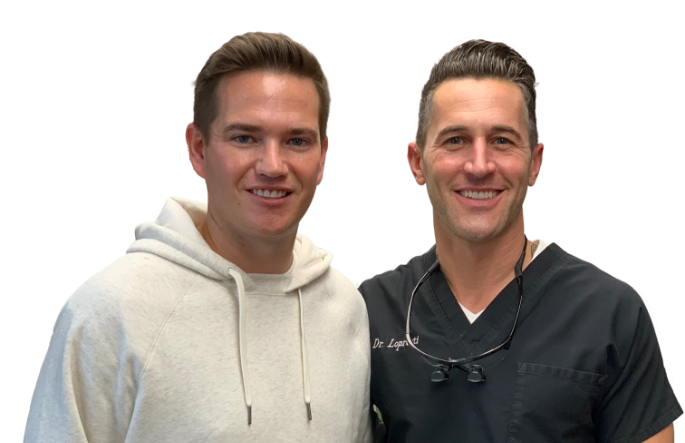
Joe F


Patient Details:
Joe Faraone Hair Transplant Results
Patient Details
Cranston, Rhode Island
Age 34 at time of treatment
Traditional FUT hair transplant
Male pattern hair loss
When You Work With Hair Every Day, You Notice What Other People Miss
Joe Faraone made his living looking at hair. As a hair stylist and salon owner in Cranston, Rhode Island, he spent his days cutting, styling and studying how hair behaved on different people. He could see recession and thinning developing in his clients. He also knew exactly what was happening to his own.
Joe had been uncomfortable with his hair loss since he was 21. As the thinning progressed, it became harder to ignore. The irony was difficult to miss. He worked in a business built around making other people feel good about their hair while becoming increasingly conscious of his own.
And there was one place Joe especially noticed it.
Under the lights.
How Does Lighting Make Thinning Hair Look Worse?
Overhead lighting can make thinning hair appear more noticeable because light reaches the exposed scalp between hairs, increasing the contrast between the hair and the skin beneath it. The less density there is, the less hair there is to diffuse that light.
Joe knew the effect well. He described avoiding overhead lights because they made the bald area on his scalp shine. It is the kind of detail that rarely shows up on a hair-loss chart, but anyone who has started choosing where to stand in a room because of the lighting understands it immediately.
Hair loss is measured in follicles. People experience it in mirrors, photographs, restaurant lighting, elevators, offices and every other place where the light happens to hit differently.
For Joe, it had reached the point where he wanted to do something about it.
A Hair Stylist Becomes the Patient
At 34, Joe met with Dr. Robert Leonard and ultimately underwent traditional FUT hair transplant surgery. This is a historical Leonard Hair Transplant Associates patient case from the period when Dr. Leonard was practicing.
With FUT, a narrow strip of donor tissue containing permanent hair follicles is surgically removed from the donor area. The follicular units are carefully separated and transplanted into areas affected by hair loss. FUT remains one of the surgical hair restoration methods performed today at Leonard Hair Transplant Associates by Chief Hair Restoration Surgeon Dr. Matthew Lopresti.
For someone who had spent his career working with hair, the standard for the finished product was naturally going to be high. Joe wasn’t looking for hair that merely existed. It had to look like it belonged there.
That is where his story gets particularly interesting.
The Best Explanation Was the Wrong One
After Joe’s hair transplant, people noticed something different about him, but they didn’t necessarily know what it was.
Joe had worn his hair in a ponytail before his procedure. When people saw him afterward, some assumed the change in his appearance came from cutting the ponytail. They didn’t immediately conclude that he had undergone hair transplant surgery.
That misunderstanding was actually a compliment.
A natural hair transplant should not announce the procedure that created it. The transplanted follicles are Joe’s own hair, and once established, the hair grows and can be cut and styled like the surrounding hair. The objective is not to create a look that makes people study the surgery. It is to create hair that makes the surgery increasingly irrelevant.
For a professional hair stylist, that distinction matters.
What Joe’s Results Show About Thinning Hair
Joe’s case is a useful example of something photographs taken under ideal conditions can sometimes miss. Hair loss does not look identical throughout the day. Density that seems acceptable in softer light may appear dramatically different beneath bright overhead lighting or in direct sunlight.
That is one reason a hair restoration evaluation involves more than simply deciding whether someone “looks bald.” Pattern, density, donor hair, progression of hair loss and long-term planning all matter. Hair loss is progressive, while donor hair is limited. The objective is to use that donor supply intelligently rather than chase whatever happens to be most noticeable under today’s bathroom light.
Joe chose surgical hair restoration after living with his hair loss for more than a decade. Looking back, he described the decision simply as “money well spent.”
For a man who spent his career looking at hair, that may be the most telling review of all.
Hair Transplant Consultation Near Cranston and Warwick, Rhode Island
For patients in Cranston, Providence and surrounding Rhode Island communities, Leonard Hair Transplant Associates offers hair restoration consultations and performs hair transplant surgery at its Warwick, Rhode Island location.
Today, Dr. Matthew Lopresti personally performs both FUE and FUT hair transplant surgery. The appropriate approach depends on the patient’s hair loss pattern, donor area, hairstyle, goals and long-term plan. The first question isn’t simply which procedure is newer. It is which approach makes the most sense for the person sitting in the chair.