



Follicular Unit Excision (FUE)
Follicular Unit Excision, commonly called FUE, uses the healthy hair you already have to create greater coverage where you want it. Your hair naturally grows in small groups called follicular units, usually containing one to four hairs. During your FUE hair transplant, these units are removed individually from your donor area and moved to the areas you would like to improve.
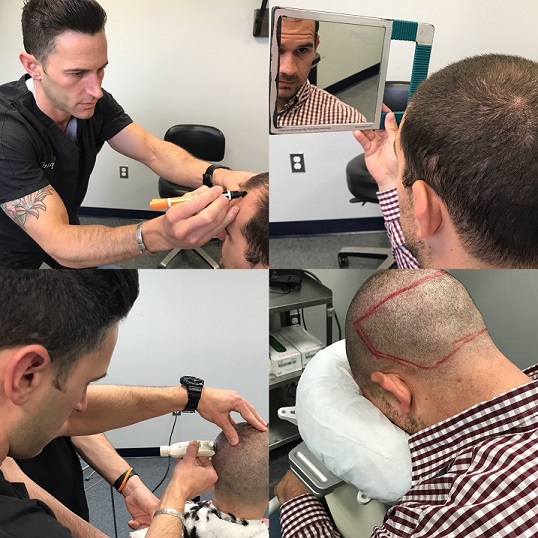
Your donor hair is taken from the back of your scalp because these follicles are generally more resistant to the hormone related process behind genetic hair loss. Since each unit is removed through a very small opening instead of a strip of scalp, you avoid a linear donor scar, although small circular scars remain.
The science explains how FUE works, but your reason for considering it is probably more personal. You want to look in the mirror without your attention going immediately to your hair. By placing each follicular unit according to the angle, direction and spacing of the hair you already have, your new growth is designed to blend naturally and feel like it belongs.
At Leonard Hair Transplant Associates, Chief Hair Restoration Surgeon Dr. Matthew Lopresti personally performs FUE hair transplant surgery in Newton, Massachusetts, and Warwick, Rhode Island. Your procedure is planned around your existing hair, available donor supply and future pattern of loss.
- Why Dr. Lopresti for FUE?
- FUE Benefits
- FUE Candidates
- FUE vs. FUT
- Preparing for FUE
- FUE Process
- FUE Recovery
- WAW and VORTEX
Why Dr. Lopresti for FUE?
An FUE hair transplant is not simply about moving follicles. It is about knowing which ones to select, where to place them and how to make the new growth feel like it has always belonged there. Every angle, direction and space matters because the best result is one that lets you look in the mirror without immediately thinking about your hair.
Chief Hair Restoration Surgeon Dr. Matthew Lopresti brings specialized training, extensive experience and a careful eye to every FUE procedure. As a Fellow of the International Society of Hair Restoration Surgery, he has presented nationally and internationally on the FUE technique and personally performs FUE hair transplant surgery in Newton, Massachusetts, and Warwick, Rhode Island.
Your donor hair is limited, which makes every follicular unit valuable. Dr. Lopresti plans your procedure around the hair you have today and how your hair loss may change in the future. The goal is not simply more coverage. It is the freedom to enjoy your hair without feeling as though you need to think about it.
Learn more about the ISHRS standards and their significance in our press release on follicular unit excision.
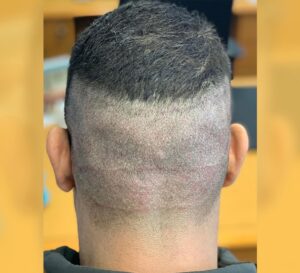
FUE donor site 1 day after surgery
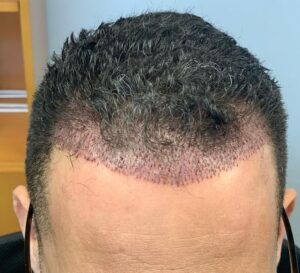
FUE recipient site 1 day after surgery
FUE may involve very small instruments, but it is still surgery. Removing follicular units requires medical judgment, technical skill and an understanding of how to protect your donor supply. The International Society of Hair Restoration Surgery uses the term Follicular Unit Excision to reinforce that follicles are surgically excised rather than simply pulled or extracted.
At Leonard Hair Transplant Associates, Dr. Matthew Lopresti personally performs FUE hair transplant surgery. Knowing who is responsible for your procedure gives you something every patient deserves before surgery begins, which is confidence that your care is being led by an experienced hair restoration surgeon.
Learn more about the updated definition and its significance in our press release on follicular unit excision.
What Are the Benefits of FUE?
FUE offers a wide range of benefits that make it one of the best techniques for certain patients. These can include:
- Faster healing in the donor area because no strip incision or sutures are required.
- No linear donor scar, although small circular scars remain where individual follicular units are removed.
- Greater flexibility to wear shorter hairstyles after the donor area has healed.
- Precise selection of individual follicular units based on your donor supply and treatment needs.
- Natural looking placement that follows the angle, direction and spacing of your existing hair.
Am I a Good Candidate for an FUE Hair Transplant?
If you have healthy donor hair at the back of your scalp, a pattern of hair loss that can be planned for and realistic expectations about coverage, you may be a good candidate for an FUE hair transplant. Perfect hair is not required. What matters is your starting point and whether a thoughtful plan can be built around it.
FUE may fit your goals if you prefer shorter hairstyles, want to avoid a linear donor scar, have a tighter scalp or need coverage in a smaller, targeted area. Previous hair transplant surgery does not automatically rule you out, but your remaining donor hair must be evaluated carefully.
The first sense of relief can come before any procedure takes place. It comes when you finally know whether there is a realistic path forward and can stop guessing. A complimentary consultation can give you that clarity, reassure you that exploring your options is a reasonable step and leave the final decision exactly where it belongs, with you.
FUE vs. FUT: Understanding Your Hair Transplant Options
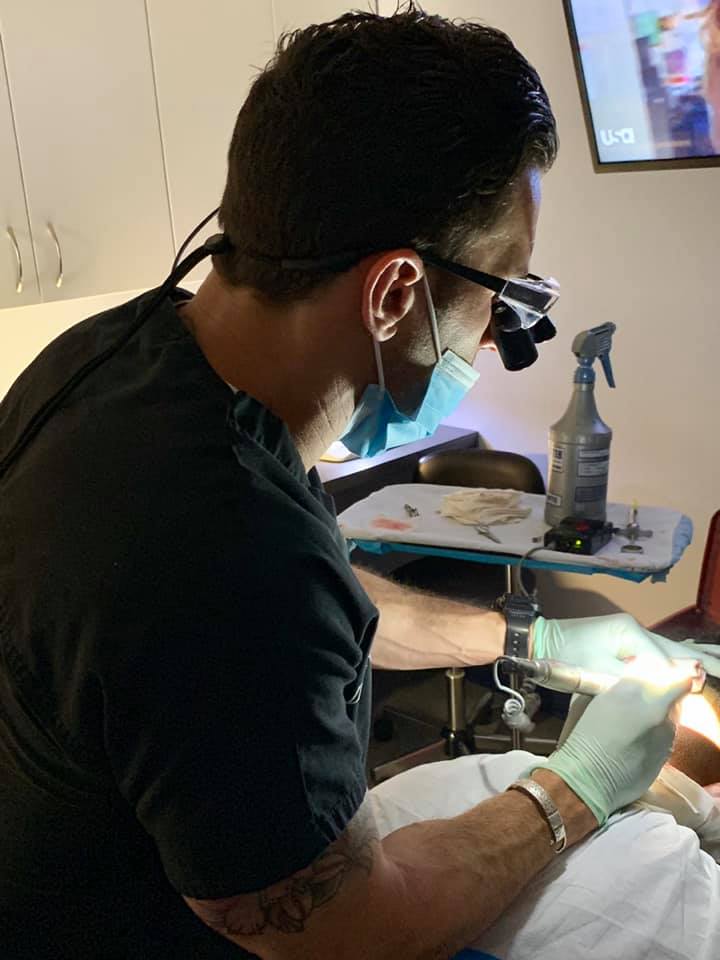
We are proud to offer some of the most technologically advanced techniques for hair transplant surgery. Two primary graft harvesting methods are used in modern hair restoration: Follicular Unit Excision (FUE) and Follicular Unit Transplantation (FUT). Closely supervised and controlled by our extensively trained hair restoration surgeon Dr. Lopresti, both approaches can achieve excellent results for the right candidate.
During your consultation, an experienced member of the hair restoration team will explain the differences between FUE and FUT. When surgery is appropriate, Dr. Matthew Lopresti determines which technique best supports your donor hair, hairstyle and long term goals.
Follicular Unit Excision (FUE)
Follicular Unit Excision (FUE) is a hair transplantation graft harvesting technique that collects follicular units directly from the scalp in a specific manner that individually selects ideal hairs. This “randomized” approach is designed to provide natural-looking results in the donor area as well as in the transplanted zone. Because FUE does not require removal of a strip of tissue, it does not create a linear donor scar.
Follicular Unit Transplantation (FUT)
During FUT, also known as the strip method, a thin section of tissue is removed from the donor area and carefully divided into individual follicular units. The incision is closed with sutures and leaves a linear donor scar that is typically covered by the surrounding hair. FUT may be appropriate depending on your donor supply, scalp characteristics and future hair restoration needs.
Choosing between FUE and FUT is not about selecting the procedure that sounds newer or more popular. It is about finding the approach that makes the best use of your donor hair and feels right for your life.
How Should I Prepare for FUE?
The days before your FUE hair transplant should not be filled with uncertainty. A clear plan can turn the unknown into a series of simple steps, allowing you to arrive knowing exactly what to expect. The Leonard Hair Transplant Associates team will provide instructions based on your health, medications and procedure so you can feel prepared rather than overwhelmed.
You may be asked to avoid certain medications or supplements that can increase bleeding, but never stop a prescribed medication without guidance from the appropriate medical provider. Because the donor area at the back of your scalp must be trimmed very closely, Dr. Matthew Lopresti generally recommends getting a tight military buzz or bald fade a few days before surgery. Comfortable clothing and an early morning arrival help make the day easier from the start.
FUE is performed using local anesthesia, and optional sedation may also be available. If you receive sedation, someone must drive you home. Preparation is really about reassurance. Every instruction answers a question before you need to ask it, replacing worry with the confidence that you are ready and that the team is ready for you.
What Does the FUE Transplant Involve?
Pre-Procedure Planning & Hairline Design
On the day of your FUE hair transplant, you will arrive at our state-of-the-art surgical facility early in the morning. Dr. Matthew Lopresti will begin by taking photographs and carefully designing your treatment area, including the hairline when applicable. This step is critical to achieving natural, age-appropriate results and allows you and your surgeon to finalize the plan together before the procedure begins.
Donor Area Preparation & Anesthesia
To perform the FUE procedure, the donor area located at the back of your scalp is trimmed very closely. A local anesthetic is then administered to numb the donor area. Patients may experience a brief pinching or burning sensation during this process, which typically lasts only a few minutes. Once the area is numb, the remainder of the procedure is generally very comfortable.
Follicular Unit Excision
Using advanced FUE technology and specialized instruments, Dr. Lopresti precisely and manually extracts individual follicular units from the donor area. This step requires a high level of technical skill and experience to preserve the integrity of each graft and promote optimal survival. Careful extraction helps ensure healthy donor healing and high-quality follicles for transplantation.
Graft Placement & Hair Restoration
Once the follicular units have been harvested, tiny incisions are created in the thinning or balding areas of the scalp. These incisions are made following the natural direction, angle, and density of your existing hair. Each follicular unit is then meticulously placed to create a seamless, natural-looking result that blends with surrounding hair.
Length of the Procedure & Same-Day Discharge
FUE hair transplant surgery is completed in one day, with the procedure averaging about 5 to 7 hours. You arrive for your procedure and go home later that same day. It may be a big day for your hair, but it doesn’t need to become an overnight stay. If you choose sedation, you will need to arrange for someone to drive you home.
What Is FUE Hair Transplant Recovery Like?
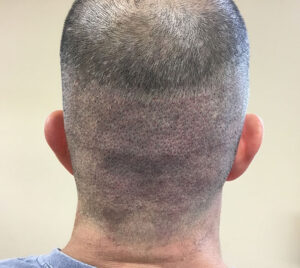
After a FUE hair transplant, the recipient area begins healing right away. Tiny scabs and some redness are normal during the first several days. Over the next week or two, the scabs shed naturally and the redness gradually fades. You can wear a loose baseball hat after surgery, which makes it easier to get back to your normal routine without feeling like everyone knows you just had a hair transplant.
The donor area also heals quickly because the follicles are removed individually. Some mild soreness or tightness can occur for the first few days, while the closely trimmed hair in the back begins growing out almost immediately. Most patients are surprised by how manageable the recovery actually is.
You will need to take it easy at first, but you are not putting your life on hold. Light exercise can usually resume after about four days, with heavier lifting and strenuous activity after about two weeks. Follow your post operative instructions, protect the newly transplanted grafts and give your scalp time to do what it does best…heal.
When Will I See Results After an FUE Hair Transplant?
You can expect to see early new hairs around 5 to 6 months after your FUE hair transplant, with a more noticeable cosmetic change around 9 to 12 months. Your hair will continue to develop and mature, with the final result generally seen around 16 to 18 months after surgery.
Here’s the science behind the wait. Transplanted follicles need time to heal, settle into their new location and move through the natural hair growth cycle before producing visible new hair. The early hairs may start out fine and gradually become longer and more noticeable as the follicles continue cycling and maturing. You won’t wake up one morning with your final result. It builds month by month, which is why patience is one of the few things we can’t speed up.
WAW and VORTEX: Advanced Tools for FUE Hair Restoration
The tool matters, but the surgeon controlling it matters more. Dr. Matthew Lopresti uses WAW and VORTEX FUE instruments to give him precise control over how individual follicular units are removed from your donor area. Different follicles can have different sizes, angles and characteristics, so having the ability to adjust the approach helps Dr. Lopresti harvest the grafts your procedure needs while being thoughtful about the donor hair you have to work with.
The WAW Device
The WAW system gives Dr. Lopresti precise control while removing individual follicular units from the donor area. Its hybrid trumpet punches can be selected based on the characteristics of your hair and follicles, giving him flexibility when working with different hair types and donor areas. The technology provides the control. The surgeon still makes the decisions.
The VORTEX Device
The VORTEX gives Dr. Lopresti another level of control during graft extraction, including the ability to manage the depth of the punch as each follicular unit is removed. That matters because follicles do not all sit beneath the skin at exactly the same depth or angle. Hair may look simple from the outside. Under the skin, it is anything but.
Having both systems available means Dr. Lopresti is not locked into one device or one way of performing FUE. He can choose the tools and approach that make the most sense for your hair, your donor area and the procedure being planned.
Learn More About FUE
To learn more about FUE and our state-of-the-art technologies, or to schedule a complimentary consultation, please contact our office today at 800-543-0660.