



Why Your Hair Transplant Surgeon Should Offer Both FUE and FUT

If you’re considering a hair transplant, you’ve probably already spent some time researching Follicular Unit Excision (FUE) and Follicular Unit Transplantation (FUT). You’ve watched videos, looked at before-and-after photographs, and maybe even spoken with a clinic that told you one procedure is clearly better than the other. I understand why that can leave you confused. You’re making an important decision about your appearance, and the last thing you need is another sales pitch disguised as medical advice.
I’m Dr. Matthew Lopresti, Chief Surgeon at Leonard Hair Transplant Associates, and one of the questions I hear most often is, “Which is better, FUE or FUT?” My answer is usually not the one people expect. Neither procedure is automatically better. The best hair transplant technique depends on your hair loss, donor hair, hairstyle, goals, and what you may need years from now. That’s precisely why I believe choosing a hair transplant surgeon who offers both FUE and FUT is so important.
When you walk into my office, I don’t want to begin by telling you which procedure you’re going to have. I want to understand what you’re hoping to accomplish, examine the hair you have available, and determine what makes the most sense for you. Because choosing a hair transplant shouldn’t be about fitting you into the procedure a clinic happens to offer. It should be about choosing the procedure that fits you.
FUE vs. FUT Hair Transplants. What’s the Difference?
Both FUE and FUT are established surgical techniques used to move healthy hair follicles from a donor area, typically the back and sides of your scalp, to areas affected by hair loss. Both can produce natural-looking, lasting results when performed appropriately. The fundamental difference is how we obtain those follicles, and that difference can influence scarring, recovery, graft planning, and the long-term management of your donor hair.
With Follicular Unit Excision (FUE), individual follicular units are removed directly from the donor area using small circular punches. The procedure avoids the linear incision associated with FUT and leaves small, scattered scars that are often difficult to notice once healed, particularly when surrounding hair provides coverage. FUE can be appealing if you prefer a shorter hairstyle or want to avoid a linear donor scar, although very closely shaved hair can still reveal the small extraction marks.
With Follicular Unit Transplantation (FUT), sometimes called the strip method, a narrow strip of donor-bearing scalp is removed and the incision is closed with sutures. The strip is then carefully dissected into individual follicular units under magnification before those grafts are placed into the recipient area. FUT leaves a linear scar that is typically concealed by surrounding hair, and it can be particularly useful when we’re planning a larger session or trying to preserve certain donor-area options for the future.
What I want you to remember is that the method of harvesting the grafts is only part of the story. Natural-looking results also depend on thoughtful hairline design, proper graft handling, recipient-site creation, the direction and angle of growth, and the overall surgical plan. A beautiful result isn’t determined by three letters. It’s determined by the decisions made before and during your procedure.
When I Recommend FUE Hair Transplant Surgery
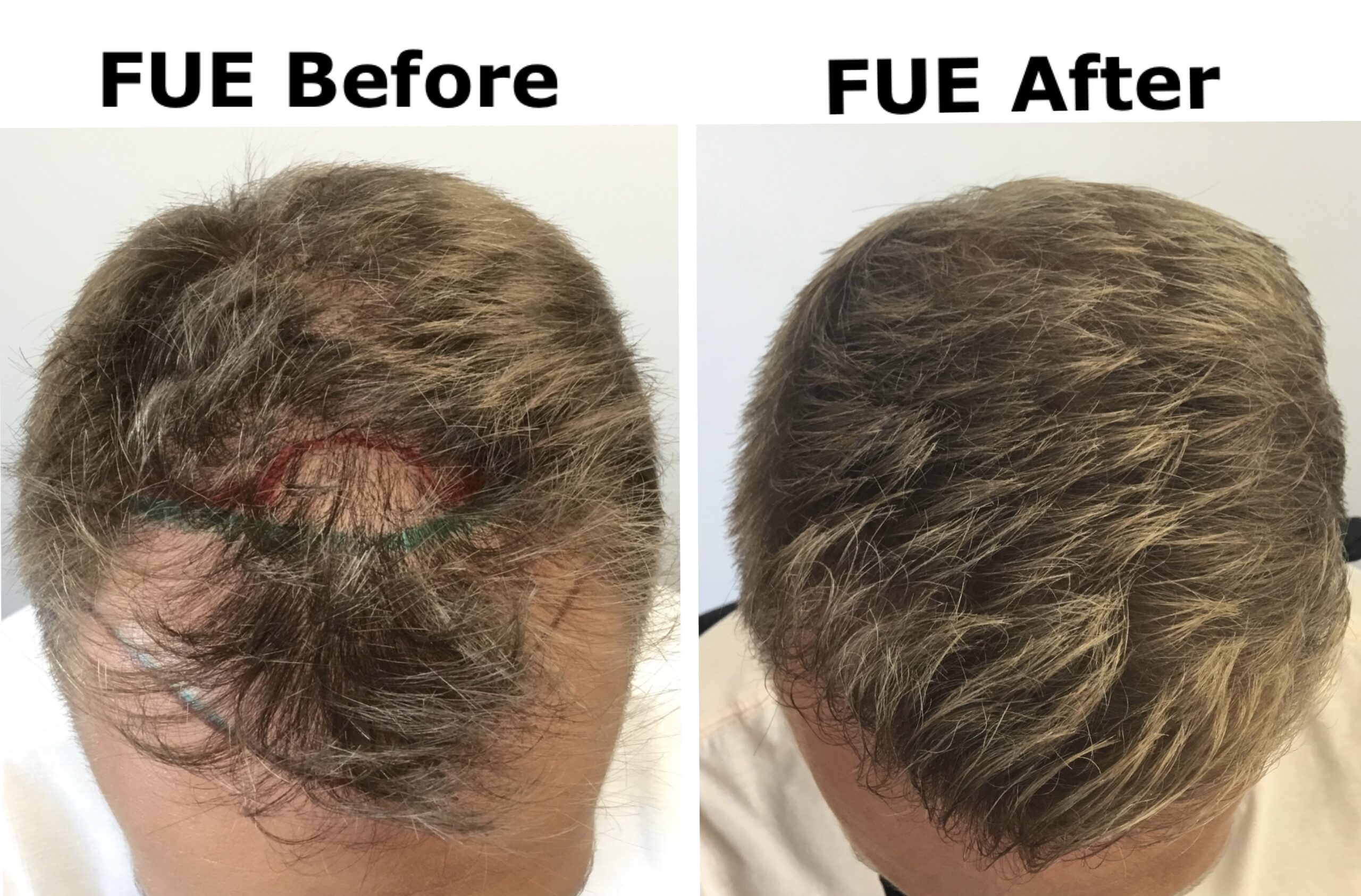 FUE is an excellent option for many patients, and there are situations where I believe its advantages are particularly meaningful. If you prefer wearing your hair relatively short, want to avoid a linear donor scar, or have characteristics that make strip harvesting less desirable, FUE may be an appropriate choice. Because the grafts are removed individually, we can distribute extractions across a carefully selected donor region while paying close attention to maintaining its overall appearance.
Another advantage is that FUE doesn’t require a linear incision or sutures in the donor area. Some patients find that their early donor-area recovery is more comfortable, although healing experiences vary, and FUE is still surgery. You’ll have small extraction wounds that need time to heal, and you’ll need to follow postoperative instructions just as carefully as you would after FUT.
I also want to correct one misconception I see repeated online. FUE is not scarless hair transplantation. Every follicular unit removed creates a small wound that heals with some degree of scarring. The difference is that FUE typically produces many small, scattered scars rather than one linear scar. That’s an important distinction, especially if someone is promising you a procedure that leaves absolutely no evidence of surgery.
At Leonard Hair Transplant Associates, our FUE procedures are planned around your individual donor supply, hair characteristics, and desired coverage. My responsibility is not simply to remove grafts successfully. It’s to make sure we’re using your available donor hair wisely while creating a result that looks appropriate today and remains sensible as you age.
Why FUT Is Still One of the Most Valuable Hair Transplant Techniques
FUT sometimes gets overlooked because FUE receives so much attention online. But newer marketing doesn’t make an established surgical technique obsolete. In the right patient, FUT remains an excellent choice, and I would never want someone to rule it out simply because a social media advertisement made it sound old-fashioned.
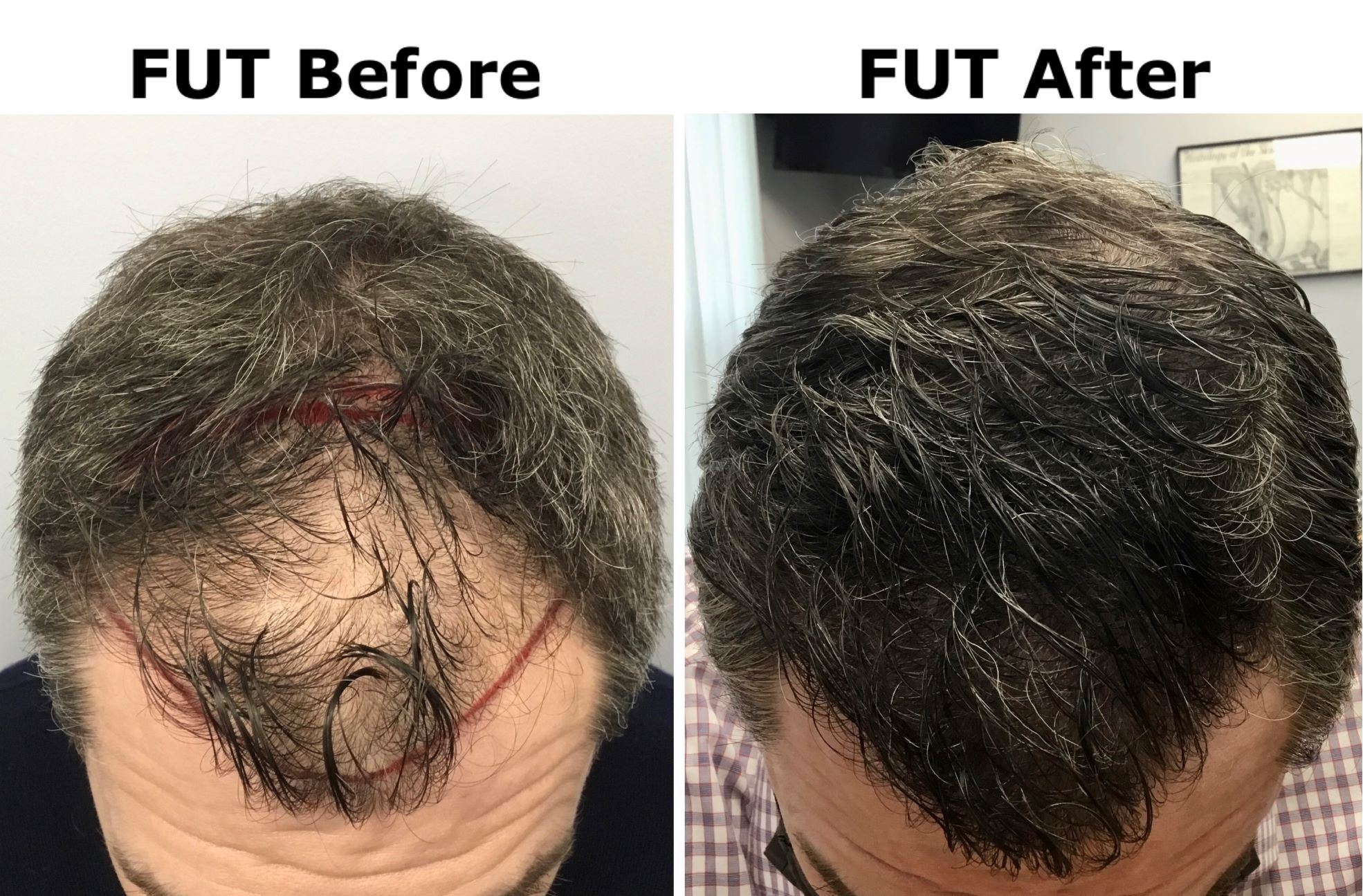 With FUT, I remove a carefully planned strip of donor-bearing scalp, close the incision, and have the tissue dissected into individual follicular units. Because the follicles are prepared from the removed strip under magnification, FUT can be an efficient way to obtain a substantial number of grafts while avoiding the widespread individual extractions associated with FUE.
For some patients with extensive hair loss, appropriate scalp laxity, and sufficient donor density, FUT may allow us to obtain the grafts needed for a larger restoration while preserving other areas of the donor scalp for possible future use. It may also be part of a thoughtful long-term strategy if additional procedures become necessary. That doesn’t mean FUT always produces more grafts or is always better at preserving donor hair. The advantages depend on the patient’s anatomy, the surgical plan, and how the donor area is managed over time.
The trade-off is the linear donor scar. If you routinely shave your head very closely, that may be an important consideration. FUT also requires sutures, which are generally removed approximately 10 to 14 days after surgery, and patients need to be mindful of activities that place tension on the healing incision. For many patients who wear their hair long enough to cover the donor area, however, the scar can remain well concealed.
I don’t believe in dismissing FUT because it isn’t the procedure everyone is talking about. I believe in evaluating whether it offers a meaningful advantage for the person sitting in front of me.
The Biggest Difference May Be What Happens Ten Years From Now
Here’s something I encourage every prospective hair transplant patient to consider. You’re not just planning for the hair loss you have today. You’re also planning for the possibility that your natural hair may continue thinning in the years ahead.
A hair transplant relocates follicles from a donor area to a recipient area. It doesn’t create an unlimited new supply of hair, and it doesn’t automatically stop the progression of genetic hair loss in the surrounding, non-transplanted follicles. That means the decisions we make during your first procedure can influence the options available to you later.
Your donor hair is a finite resource. Whether we’re performing FUE or FUT, we have to consider how many grafts can be safely harvested, how the donor area will look afterward, and what might happen if you need additional coverage in the future. Excessive FUE harvesting can leave the donor area visibly thin or uneven. Repeated FUT procedures have their own limitations involving scalp laxity, scarring, and available tissue. Neither technique should be treated as an unlimited source of grafts.
This is where offering both procedures becomes especially valuable. I can evaluate the advantages and limitations of each approach rather than starting with the assumption that everyone should have the same surgery. Sometimes FUE is the clear choice. Sometimes FUT makes more sense. And for certain patients, a carefully planned combination or sequence of techniques may be worth discussing over the course of their hair restoration journey.
The best hair transplant plan isn’t necessarily the one that uses the most grafts today. It’s the one that achieves an appropriate result without unnecessarily compromising your options tomorrow.
What Concerns Me About Clinics That Only Offer One Procedure
I want to be fair here. There are skilled, ethical hair transplant surgeons who specialize in FUE, and offering only one technique does not automatically make a clinic unqualified. What concerns me is when a practice presents its preferred procedure as the best choice for virtually everyone, without explaining the alternatives or acknowledging circumstances in which another approach might be more appropriate.
If you’re meeting with a surgeon who offers only FUE, I would encourage you to ask whether FUT might provide any advantages in your particular situation. If the answer is an immediate dismissal without a meaningful examination of your donor area, scalp characteristics, and future hair loss, I think that’s worth questioning. The same standard applies to any practice that recommends FUT without seriously considering whether FUE might better fit your needs.
You deserve an explanation that goes beyond convenience, advertising, or whatever equipment a clinic has invested in. You should understand why a particular technique is being recommended, what its limitations are, and how it fits into a longer-term plan. And you should feel comfortable seeking a second opinion before making a decision.
That’s one of the reasons I value being able to discuss both techniques with patients. It allows our conversation to begin with your needs rather than the limitations of a single surgical approach.
A Word About Cheap Hair Transplants Overseas
If you’ve researched hair transplantation online, you’ve almost certainly encountered advertisements promoting low-cost FUE packages overseas, particularly in Turkey. Some include hotel accommodations, transportation, and promises of thousands of grafts at prices that seem difficult to ignore. I understand the appeal, especially when you’re comparing the cost of a hair transplant in Boston with a package advertised for a fraction of the price.
But I would encourage you to look beyond the price tag and ask who will actually be performing your surgery. Hair transplantation is a medical procedure that requires careful donor evaluation, surgical planning, technical skill, and appropriate follow-up care. These considerations matter regardless of whether your procedure takes place in Massachusetts, Rhode Island, Turkey, or anywhere else.
There are qualified physicians practicing internationally, and it would be inaccurate to suggest that every overseas clinic operates irresponsibly. However, high-volume clinics that rely heavily on nonphysician personnel, perform inadequate patient evaluations, or prioritize large graft counts over donor preservation can create serious problems. Those risks aren’t exclusive to one country, either.
Overharvesting, unnatural hairline design, poor graft survival, infection, and visible scarring can be difficult and sometimes impossible to fully correct. And when your surgeon is thousands of miles away, managing complications or arranging follow-up care may become considerably more challenging.
Before choosing any hair transplant clinic, I would ask who performs the critical surgical steps, what qualifications the physician holds, how donor harvesting is planned, what happens if complications arise, and whether the clinic offers an individualized assessment of both FUE and FUT. Those answers tell you far more about the quality of your care than a promotional package ever will.
What Should You Look for in a Boston Hair Transplant Surgeon?
If you’re searching for the best hair transplant surgeon in Boston, Newton, or the surrounding New England area, I would encourage you to look beyond before-and-after photographs and advertised graft prices. Results matter, of course, but so does understanding how those results were achieved and whether the surgeon is recommending a procedure that makes sense for your particular situation.
Start by asking about the surgeon’s training, experience, and qualifications in hair restoration surgery. Find out whether they personally evaluate your donor area and participate in the critical surgical aspects of your procedure. Ask to see results from patients with hair characteristics and patterns of loss similar to yours, and make sure you understand what the recovery process, scarring, and realistic timeline will look like.
Most importantly, ask why the surgeon recommends FUE or FUT for you. A thoughtful answer should include your donor density, hair caliber, scalp laxity, hairstyle preferences, extent of hair loss, and the possibility of future progression. If the conversation never moves beyond how many grafts you can purchase, you may not be getting the full picture.
I’m a Diplomate of the American Board of Hair Restoration Surgery and a Fellow of the International Society of Hair Restoration Surgery. At Leonard Hair Transplant Associates, we welcome patients from Boston, Newton, throughout Massachusetts, Rhode Island, New Hampshire, and across New England. Our hair transplant surgeries are performed in Newton Centre, Massachusetts, and Warwick, Rhode Island, with additional consultation opportunities at our Boston office.
When I meet with you, my goal is to explain your options clearly, answer your questions, and help you understand what can realistically be accomplished. That may mean recommending FUE, recommending FUT, discussing medical hair loss treatments as part of a longer-term strategy, or advising you to wait if surgery isn’t the right decision at that point.
The Right Hair Transplant Starts with the Right Conversation
I understand that choosing to have a hair transplant is a significant decision. You may have spent years thinking about it, comparing photographs, researching surgeons, and wondering whether you’ll be happy with the result. By the time you schedule a consultation, you deserve more than a presentation about one procedure and a quote for a certain number of grafts.
You deserve to understand your hair loss, your donor supply, and the choices available to you. You deserve to know what each procedure can accomplish, where its limitations begin, and how today’s decisions may affect your hair years from now.
That’s why I believe the ability to offer both FUE and FUT matters. Not because every patient needs both, or because one is always superior, but because your treatment should be selected for you, not selected for you by the limitations of the clinic.
At Leonard Hair Transplant Associates, we’re here to help you make that decision with accurate information, realistic expectations, and a plan built around your individual needs.
You only have one donor supply. Make sure the surgeon you choose is thinking about all of it, not just the next procedure.
If you’re considering a hair transplant in Boston or anywhere in New England, I invite you to schedule a complimentary consultation with our team at Leonard Hair Transplant Associates. We’ll discuss your hair loss, evaluate your options, and help determine whether FUE, FUT, or another approach makes the most sense for you.