



Should You Get a Hair Transplant in the Crown? Why Timing Matters
If you are in your 20s or 30s and starting to see the crown of your scalp through your hair, there is a good chance your first instinct is pretty simple: put hair back where it is disappearing. You see the thinning every time you stand under bright bathroom lights, catch the back of your head in a photograph or look at yourself on a security camera from an angle you never asked to see, and suddenly the crown becomes the only part of your hair you notice. If hair transplant surgery can move permanent hair into that area, why not take care of it now before it gets worse?
Because with the crown, fixing what bothers you today can sometimes make it harder to fix what bothers you ten years from now.
That is especially important for younger men because male pattern hair loss is progressive. The crown you see at 28 may not be the crown you have at 38, and the four inch area that bothers you now may eventually become part of a much larger area of thinning. A hair transplant can move follicles into the crown, but it cannot guarantee that the native hair surrounding those transplanted follicles will remain there for the rest of your life.
This is why Dr. Matthew Lopresti does not evaluate a crown transplant simply by asking whether there is enough empty space to put grafts into today. The bigger question is what your entire pattern of hair loss may look like years from now and whether using a portion of your limited donor hair in the crown now makes sense as part of that longer plan.
For younger men in particular, that difference matters.
The Crown Is Not Just Another Bald Spot
The crown, sometimes called the vertex, is the area toward the back of the top of your scalp where the hair typically grows in a circular or spiral pattern known as a whorl. When male pattern hair loss begins affecting this area, the first change may be subtle. You might notice more scalp in the center of the whorl, a spot that looks larger under overhead lighting or an area that seems thinner when your hair is wet.
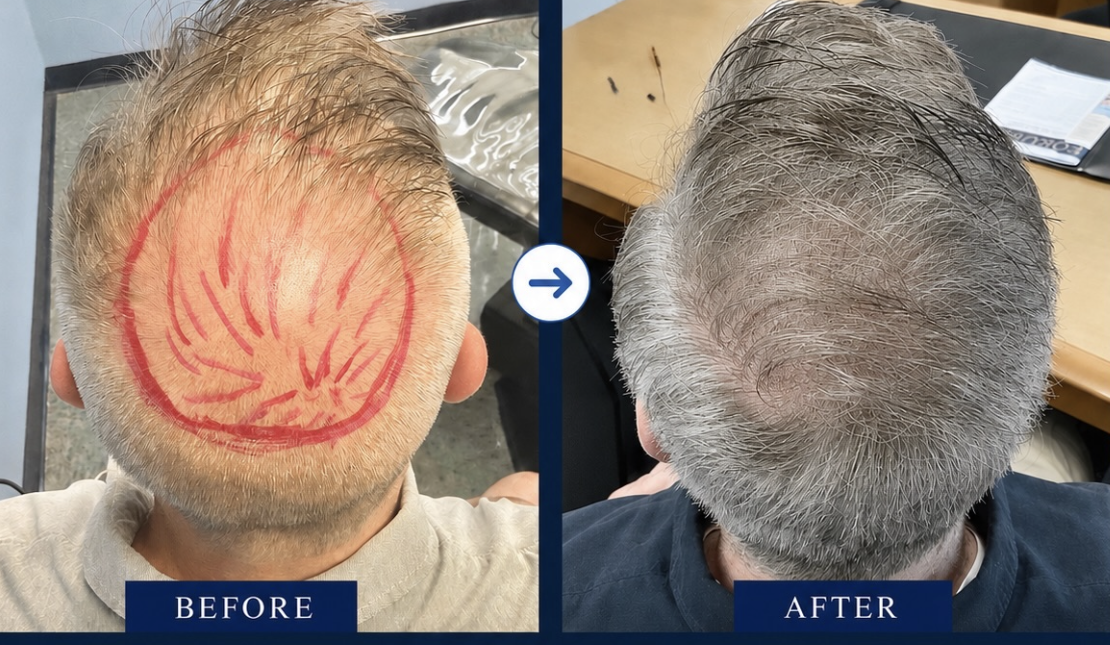 As the process continues, genetically susceptible follicles can gradually miniaturize. The hairs they produce become finer, shorter and less effective at covering the scalp. Eventually, an area that once looked slightly thin can become substantially larger.
That progression creates a unique problem for hair transplant planning because the crown is not a fixed target.
Imagine drawing a circle around the area that bothers you today and transplanting that entire circle. If the native hair immediately outside that circle continues to miniaturize over the next several years, the transplanted hairs can remain while the surrounding natural hair becomes thinner. Instead of having one gradually thinning crown, you can eventually have a transplanted area surrounded by additional hair loss.
The transplant did not fail. The hair loss kept moving.
That is the part younger patients sometimes do not think about because the instinct is understandably to fix what they can see right now. Good hair restoration planning has to think about what you cannot see yet.
Your Donor Hair Is a Bank Account You Cannot Refill
This may be the single most important concept to understand before having any hair transplant.
A hair transplant does not create new follicles. Whether Follicular Unit Excision, or FUE, or FUT surgery is used, follicles are being relocated from the donor area into areas where greater coverage is desired. Once those grafts have been moved, you cannot magically replace them in the donor supply and use them somewhere else later.
That means every graft has value.
Think of your donor hair as a lifetime account with a limited balance. If you are 27 and beginning to lose hair in both the front and crown, the question is not simply whether you have enough grafts to improve both areas today. Dr. Lopresti also has to consider what could happen if your loss progresses through your 30s, 40s and beyond.
Where will you want those grafts then?
That is why hair transplant planning sometimes requires restraint. A younger patient may understandably want every thinning area addressed immediately, while a surgeon looking at the same scalp may see a much longer story developing. The goal is not to win the photograph taken six months from now and lose the one taken fifteen years from now.
A good hair transplant should age with you.
Why Can the Crown Use So Many Grafts?
Hair in the front of the scalp generally travels in a direction that can help create the visual impression of coverage. The crown is different because the natural hair rotates around the whorl. To recreate that pattern naturally, grafts have to be positioned with careful attention to angle, direction and the existing architecture of the patient’s hair.
There is also a geometry problem.
As a thinning crown expands, the surface area that needs coverage increases substantially. A slightly larger diameter does not mean only a slightly larger area. Because the area of a circle increases with the square of its radius, what looks like a modest expansion of crown loss can translate into considerably more scalp requiring coverage.
That is where the math begins competing with the mirror.
You may see a bald spot that you want filled. Dr. Lopresti has to see that spot, the potentially thinning hair surrounding it, your donor density, your hair caliber, your hair characteristics, your age, your family history and the possibility that you may eventually want additional surgery elsewhere.
This is why the crown can consume a large number of grafts while still appearing less dramatically transformed than a patient expected. It is not simply about putting hair into an empty space. It is about distributing a finite number of follicles over an area large enough to create the appearance of useful density.
Why Being Under 40 Changes the Conversation
There is nothing magical about your 40th birthday. You do not wake up that morning with a completely predictable lifetime pattern of hair loss.
 But age provides information.
When significant crown thinning appears in a man in his 20s or early 30s, there may be many years of future hair loss still ahead. That does not automatically mean he cannot have hair transplant surgery, and it certainly does not mean every man under 40 should be treated the same way. It means long-term planning becomes particularly important because there is more time for the pattern to evolve.
A 29-year-old with early crown thinning, strong donor density and limited loss elsewhere presents a different planning problem from a 29-year-old who is already showing substantial miniaturization through the front, midscalp and crown. The birthday is the same. The hair-loss situation is not.
Family history can provide additional clues, but it is not a crystal ball either. You cannot look at your father, grandfather or older brother and assume your scalp will follow exactly the same path. Male pattern hair loss has a complex genetic basis, and different men in the same family can develop very different patterns and degrees of loss.
That is why an evaluation is more useful than a rule based solely on age.
The Hair You Still Have May Matter More Than the Hair You Have Already Lost
When younger men look at their crown, their attention naturally goes to the scalp they can see. From a planning standpoint, the hairs still growing around that area can be just as important.
Some may be healthy, full caliber hairs. Others may already be undergoing miniaturization even though they are still visible.
Miniaturization is one of the reasons hair loss can fool you. A follicle does not necessarily go from producing a thick terminal hair one day to producing nothing the next. With androgenetic alopecia, genetically susceptible follicles can progressively produce finer, shorter hairs over repeated growth cycles. Coverage gradually decreases even though there may still be hair throughout the area.
That means a crown that looks reasonably contained today can include surrounding follicles that are already changing.
If surgery is planned as though every existing native hair will remain indefinitely, the transplant may look excellent initially but become increasingly isolated as those native hairs continue to thin. Long-term planning therefore involves more than counting the hairs that are missing. It requires thinking about the hairs that may be at risk.
This Is Why Stabilizing Hair Loss Can Matter Before Surgery
For some younger men with crown thinning, the smartest first move may not be surgery.
Depending on the individual patient, Dr. Lopresti may discuss non-surgical treatment options intended to help manage progressive pattern hair loss. These can include treatments such as finasteride, minoxidil or PRP with ACell when medically appropriate. The right treatment is individual, and no medication or procedure should be presented as a guarantee that hair loss will stop permanently.
The strategic reason for considering treatment before committing donor grafts is straightforward. If existing miniaturized hairs can be maintained or improved and the pattern becomes more stable, you may get a clearer picture of what actually needs to be transplanted. You may also preserve donor hair for areas that become more important later.
That can feel frustrating when you walked into an appointment wanting surgery now. But hair restoration is one of those situations where doing more is not automatically doing better.
Sometimes patience is part of the procedure.
What Happens If You Transplant the Crown Too Aggressively?
Imagine a 31-year-old man with thinning in the crown who wants the area filled as densely as possible. He has good donor hair and could potentially move a substantial number of grafts into that area. If the decision were based only on what would make the crown look best today, aggressive transplantation might seem appealing.
Now move the clock forward fifteen years.
Suppose his native hair continues to thin through the midscalp and front. He may now care much more about framing his face and maintaining coverage across the top of his scalp than he did at 31. But a significant portion of his available donor grafts has already been committed to the crown.
Those grafts are doing exactly what they were supposed to do. The problem is that they cannot be spent twice.
This is why donor management is not simply a surgical issue. It is resource management.
Younger patients have to think in decades.
Why the Front of the Scalp May Take Priority
For many patients with more extensive hair loss, the front of the scalp can have a greater visual impact than the crown because it frames the face. That does not mean the crown is unimportant or should never be transplanted. It means priorities matter when donor hair is limited.
A man with an unlimited supply of permanent donor follicles could simply restore every thinning area as it appeared. No one has that luxury.
The surgeon therefore has to think about how donor hair can create the greatest long-term cosmetic benefit. Depending on the patient’s pattern, that can mean protecting resources for the frontal area and midscalp before committing a large number of grafts to the crown.
For a younger man staring at his crown in the mirror, this can sound like solving a problem he does not have yet.
That is exactly the point.
Can a Crown Hair Transplant Look Natural?
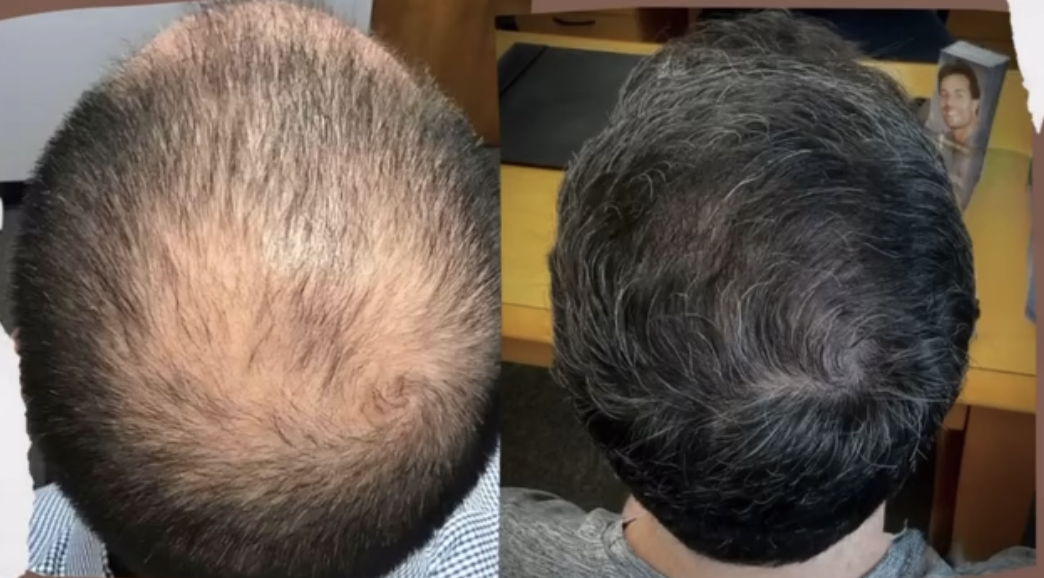 Absolutely, when the patient is an appropriate candidate and the procedure is properly planned.
The natural whorl pattern has to be respected, and graft direction and angle matter considerably. The objective is not simply to cover visible scalp with as many hairs as possible. It is to recreate the way hair naturally emerges and travels through that region while using the available grafts efficiently.
Hair characteristics also influence the visual result. Hair caliber, curl, color contrast between the hair and scalp, donor density and the size of the area being treated can all affect how much coverage a given number of grafts appears to provide.
Two men can receive the same number of grafts in similarly sized crowns and look different afterward because hair transplantation is not a paint-by-numbers procedure.
This is also why comparing your crown to a photograph of somebody else’s result can be misleading. You are looking at the photograph. A surgeon has to look at the biology underneath it.
So, When Is the Right Time to Transplant the Crown?
There is no single age, number of grafts or amount of thinning that answers that question for everyone.
The right time depends on the stability and extent of your hair loss, the amount and quality of your donor hair, what is happening in the front and midscalp, your response to any appropriate non-surgical treatment, your hair characteristics and what your likely long-term needs may be.
For some men, crown transplantation can make sense at a younger age. For others, waiting while treating and monitoring progressive loss can protect options they may be very glad to have later.
That is why a consultation should not simply answer, “Can we put grafts there?”
The better question is, “If we put grafts there now, will this still look like a smart decision years from now?”
At Leonard Hair Transplant Associates, Dr. Matthew Lopresti evaluates men with crown hair loss from Boston, Newton, throughout Massachusetts and across New England with that longer view in mind. FUE and FUT hair transplant surgery can create meaningful improvement for properly selected patients, but the procedure has to be designed around the patient’s future as much as the hair loss visible today.
If you are 25, 30 or 35 and the crown is starting to bother you, wanting to fix it is completely understandable. Just remember that you are not buying hair by the square inch. You are deciding where to place a limited number of permanent follicles that you may want for the rest of your life.
The best crown transplant is not necessarily the one you can do the earliest. It is the one that still makes sense when you are older.