


Sean Kuraly PRP with ACell Hair Restoration
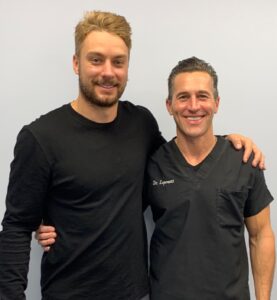
Boston Bruins forward Sean Kuraly chose PRP with ACell at Leonard Hair Transplant Associates after noticing something in old photographs that he had not been seeing in the mirror. His hairline was changing.
Sean did not have a hair transplant. After meeting with Dr. Matthew Lopresti and discussing his hair loss, goals and treatment options, he chose PRP with ACell, a non-surgical hair restoration treatment intended to help stabilize hair loss and improve the density and quality of existing hair.
Back in Black and Gold
Sean Kuraly is an NHL forward whose career has become closely tied to Boston. He spent his first five NHL seasons with the Boston Bruins, helped the team reach the 2019 Stanley Cup Final and became known for the physical, high energy style of hockey Boston fans tend to appreciate.
After four seasons with the Columbus Blue Jackets, Sean returned to the Bruins in 2025 for his second stint in Boston. He played the 2025–26 season back in Black and Gold, bringing his career full circle to the city where he first established himself in the NHL.
Long before that return, Boston was also where Sean decided to do something about his changing hair. Rather than waiting until his hair loss became advanced, he came to Leonard Hair Transplant Associates to find out what could be done while he still had plenty of hair worth protecting.
The Photograph That Got His Attention
Hair has always been part of hockey culture. Grow it out. Shove it under a helmet. Let it go during the playoffs. Sean had always had plenty of it.
“As a kid, I had a lot of hair and was always begging for a buzz cut, but wound up with a spiked-in-the-front look that I rocked for most of my childhood,” he joked.
So hair loss was not something he spent much time thinking about. Then he looked at photographs from a few years earlier.
“I was looking at photos from my early 20s and I noticed a big difference in my hairline. It was definitely receding and I was surprised because I hadn’t realized it until I saw those photos.”
That realization is familiar to a lot of people experiencing gradual hair loss. When you see yourself every day, small changes can be easy to miss. Put two photographs taken several years apart next to each other and the difference can suddenly become much easier to see.
For Sean, that photograph was enough to start asking questions.
Staying Ahead of Hair Loss
Sean came to Leonard Hair Transplant Associates while he still had a substantial amount of existing hair. That gave the conversation with Dr. Lopresti a different objective.
This was not about replacing large areas of permanently lost hair. It was about trying to protect and improve the hair Sean still had.
Hair loss is progressive, which is one reason Dr. Lopresti believes there can be an advantage to addressing it before thinning becomes advanced. Depending on the patient and diagnosis, non-surgical treatments may help stabilize continued hair loss while improving the thickness, density and quality of existing hair.
Sometimes the smartest hair restoration move is not replacing hair. It is fighting to keep it.
Why Sean Chose Leonard Hair Transplant Associates
Sean already knew the practice by reputation and through other NHL players who had been treated there.
“The practice has a great reputation around the city. Everyone who I know that has gone there has been super happy with the results.”
But reputation got him through the door. The consultation had to do the rest.
Sean came prepared with questions for Dr. Lopresti about his options and what he could realistically expect from treatment.
“Dr. Lopresti is an incredibly personable and likeable guy. He was so easy to talk to and I really pressed him with some hard questions and the results that I could expect depending on the treatment I chose. I was really comfortable after my consultation and satisfied that I was making the right choice.”
That is exactly what a hair loss consultation should be. Not a sales pitch. A chance to ask hard questions and get enough information to make your own decision.
Choosing PRP with ACell
After evaluating Sean’s hair loss, Dr. Lopresti recommended PRP with ACell as a non-surgical treatment option to help stabilize his hair loss and improve the hair he still had.
PRP with ACell uses components from the patient’s own blood together with ACell and is injected into targeted areas of the scalp. The goal is to support existing follicles and improve the quality and density of thinning hair.
For Sean, another consideration was downtime. As a professional hockey player, his schedule revolved around practices, games, travel and training. A non-surgical treatment that did not require the recovery associated with hair transplant surgery made sense for where his hair loss was at the time.
PRP with ACell and hair transplant surgery do different jobs. Hair transplant surgery moves permanent donor follicles into areas where hair has been lost. PRP with ACell is intended to work with follicles that are still there.
Sean still had hair worth fighting for.
His First Treatment
Sean had never undergone what he considered a cosmetic procedure, so there were some nerves going into his first PRP with ACell treatment.
“PRP was unlike anything I’d ever done. I’ve never had what would be considered a cosmetic procedure before.”
Once treatment began, his concern faded.
“It was pretty easy, minus the pinching from the anesthetic. Once we got my head numb, it didn’t take a lot of time, was easy and not too invasive.”
Sean later described some mild soreness after treatment but said he was back to his normal routine quickly.
That was Sean’s experience. Recovery and discomfort can vary from patient to patient, and anyone considering PRP with ACell should discuss what to expect with the clinical team rather than assuming another patient’s experience will be their own.
Then the Locker Room Heard About It
Sean did not exactly keep his treatment a secret.
“I couldn’t wait to tell my teammates. I was bragging about it actually,” he laughed. “I’ve already had a number of the guys ask to go in for a consultation.”
That may say as much about his experience as anything else on this page.
Hair loss used to be something a lot of men quietly accepted and rarely discussed. Sean took a different approach. He noticed it, asked questions, chose to treat it and then went back to the locker room and talked about it.
A few years later, Boston Bruins teammate Charlie McAvoy would also choose Leonard Hair Transplant Associates when he decided to address his own hair loss.
One conversation has a way of starting another.
Hair Restoration Does Not Always Mean Hair Transplant Surgery
Sean’s story is also a useful reminder that coming to a hair transplant practice does not mean you need a hair transplant.
The right treatment depends on what is happening with your hair now.
For some patients, that may eventually mean FUE or FUT hair transplant surgery. For others, particularly those who still have existing hair that may benefit from treatment, Dr. Lopresti may discuss non-surgical options such as PRP with ACell, finasteride or minoxidil when medically appropriate.
The objective is not to fit every patient into the same treatment. It is to understand what hair is being lost, what hair can still be protected and what approach makes sense for the long term.
Start While There Is Hair to Protect
Sean did not come to Leonard Hair Transplant Associates because he was bald. He came because he noticed he was heading in a direction he did not particularly like.
That is an important distinction.
You do not have to wait until hair loss becomes advanced to find out what your options are. A free consultation with Leonard Hair Transplant Associates can help determine what type of hair loss you are experiencing and whether PRP with ACell, medication, FUE, FUT or simply monitoring your hair makes sense for you